
Waterjet Knowledge
Why Does a Waterjet Focusing Tube Wear Out Quickly?
Why Does a Waterjet Focusing Tube Wear Out Quickly?
The Waterjet Focusing Tube (also known as a Mixing Tube or Abrasive Nozzle) is one of the most frequently replaced consumables in abrasive Waterjet Cutting Systems.
Gradual wear is normal, as garnet abrasive passes through the focusing tube at extremely high speeds. However, if the tube wears out much faster than expected, the issue may not lie with the tube itself.
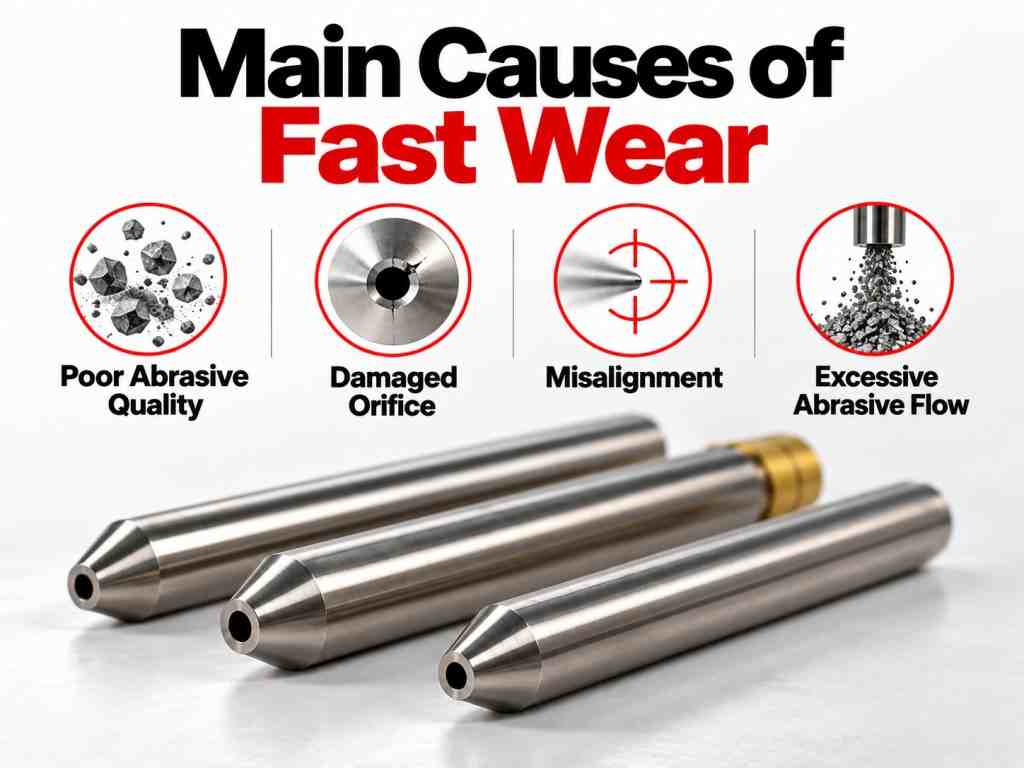
Factors such as abrasive quality, the condition of the jewel orifice, alignment, abrasive flow rate, and the material of the focusing tube all influence its service life.
1. Poor Abrasive Quality
Abrasive material is a primary factor influencing the wear of the focusing tube.
Low-quality garnet may exhibit the following issues:
Excessive dust
Oversized particles
Irregular particle shapes
Presence of impurities
High moisture content
These issues can accelerate internal wear or lead to unstable abrasive flow.
Using clean, dry garnet with the appropriate particle size helps improve cutting stability and reduces unnecessary wear on the focusing tube.
2. Incorrect Abrasive Mesh Size
The abrasive particle size must be compatible with the cutting system and the focusing tube.
If abrasive particles are too large relative to the inner diameter of the focusing tube, friction may increase and cause clogging.
Garnet abrasive with a mesh size of 80 is commonly used for waterjet cutting, though the specific grade depends on the equipment type and the cutting application.
Always adhere to the requirements specified for the cutting head and the abrasive delivery system.
3. Damaged or Worn Orifice
Before the water stream enters the mixing chamber and the focusing tube, the nozzle (orifice) generates a high-speed water jet.
If the nozzle is damaged or worn, the water jet may no longer travel straight through the center of the focusing tube.
Instead, the jet may strike the inner walls.
This can result in:
Uneven internal wear
Reduced service life of the focusing tube
Widened cutting kerf
Instability of the cutting jet
Degraded cutting quality
The nozzle should also be inspected if the focusing tube is found to be wearing out unusually fast.
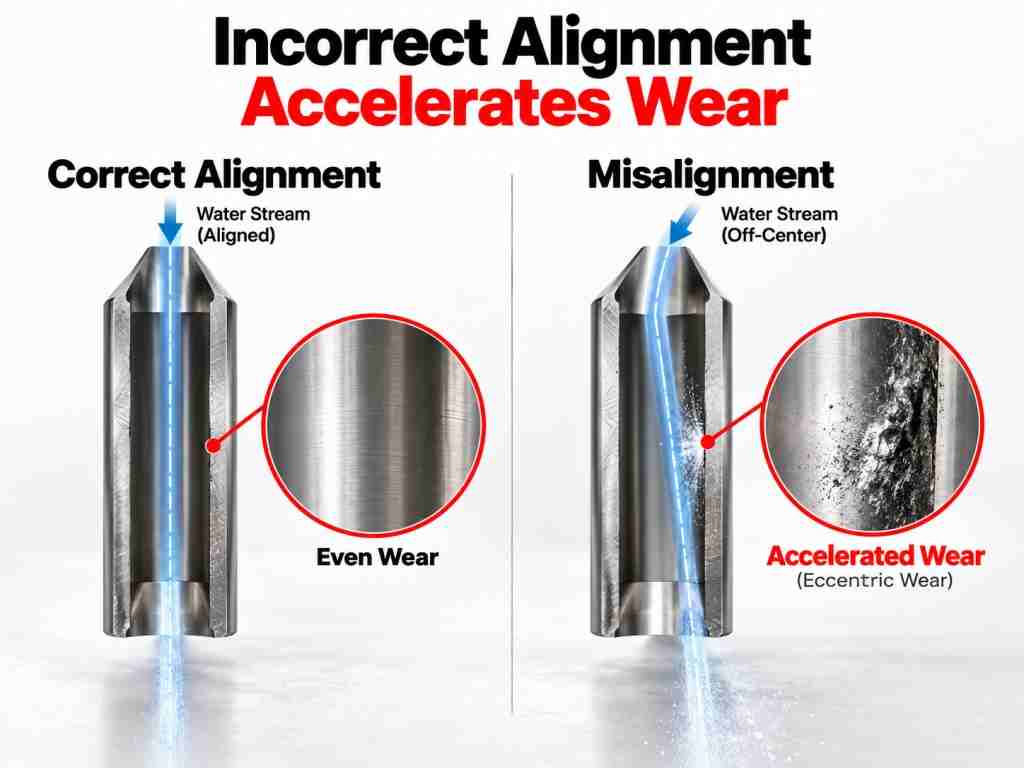
4. Poor Orifice and Focusing Tube Alignment
Proper alignment is crucial.
The water stream should enter the focusing tube as centrally as possible.
If the nozzle, mixing chamber, or focusing tube is misaligned, the jet may continuously strike one side of the focusing tube.
This can lead to uneven wear and significantly shorten the service life.
Possible causes include:
Improper installation
Damage to the cutting head assembly
Debris inside the components
Wear on locating surfaces
Use of mismatched replacement parts
Keeping the cutting head clean and using properly matched components helps minimize alignment issues.
5. Excessive Abrasive Flow
Increasing the amount of abrasive does not always result in better cutting performance.
If an excessive amount of garnet abrasive enters the focusing tube, internal wear may intensify without a proportional increase in cutting efficiency.
Excessive abrasive usage also leads to increased costs or burdens, such as:
Consumable costs
Garnet consumption
Nozzle wear
Waste disposal costs
Abrasive flow rates should be adjusted based on material thickness, cutting speed, pump pressure, and the nozzle configuration.
6. Incorrect Focusing Tube Size
The focusing tube must be matched to the nozzle (orifice) and the specific cutting application.
Key specifications include:
Inner diameter, outer diameter, length, and cutting head compatibility.
An incorrect inner diameter can lead to poor abrasive mixing or unstable abrasive flow.
For example, common inner diameter specifications include:
0.76 mm, 0.89 mm, 1.02 mm, and 1.14 mm.
However, the specific dimensions depend on the waterjet system being used.
7. Poor Focusing Tube Material
Focusing tubes are typically made of highly wear-resistant cemented carbide.
However, products from different suppliers may vary in terms of material quality and manufacturing precision.
Substandard focusing tubes may exhibit issues such as:
poor wear resistance, poor inner bore surface finish, inaccurate inner bore geometry, and inconsistent dimensions.
Even with correct machine parameter settings, these issues can lead to a shortened service life for the focusing tube.
Therefore, it is crucial to select focusing tubes that offer consistent material quality and precise dimensions.
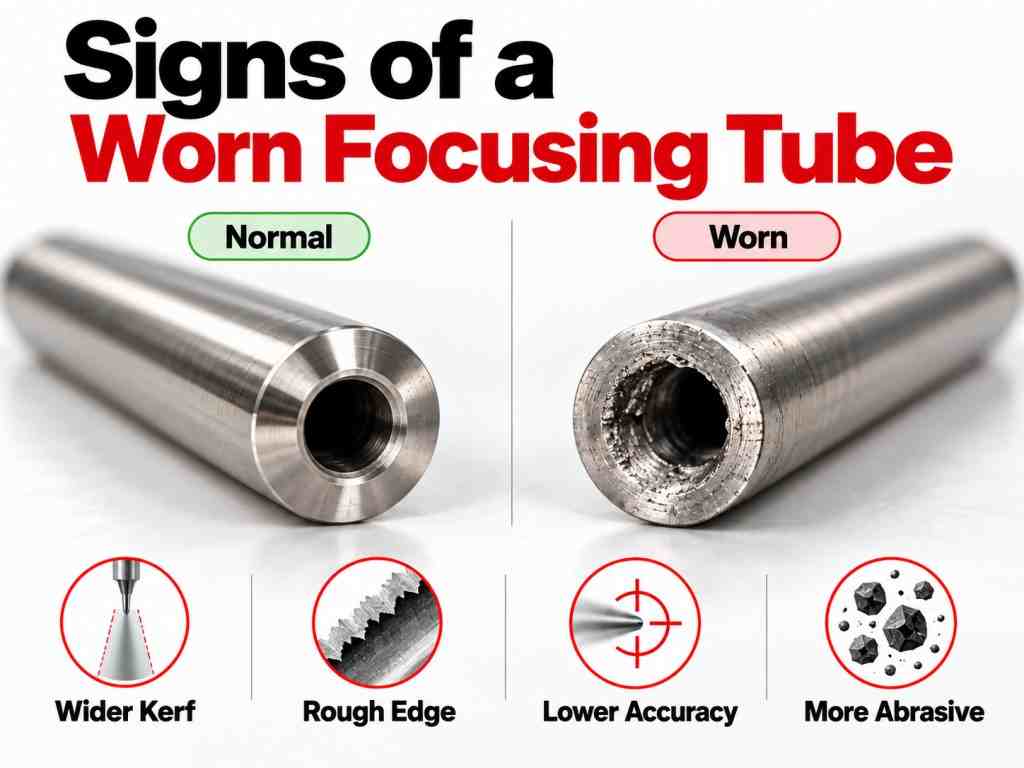
How Can You Tell the Focusing Tube Is Wearing Out?
Focusing tube wear may result in:
Widening of the kerf, rough cut edges, reduced cutting accuracy, slower cutting speeds, increased abrasive consumption, an unstable cutting jet, and poor surface finish.
If these symptoms appear gradually, please inspect the focusing tube and the nozzle (jewel orifice).
If the same problem recurs, do not simply replace the focusing tube.
How to Extend Focusing Tube Service Life
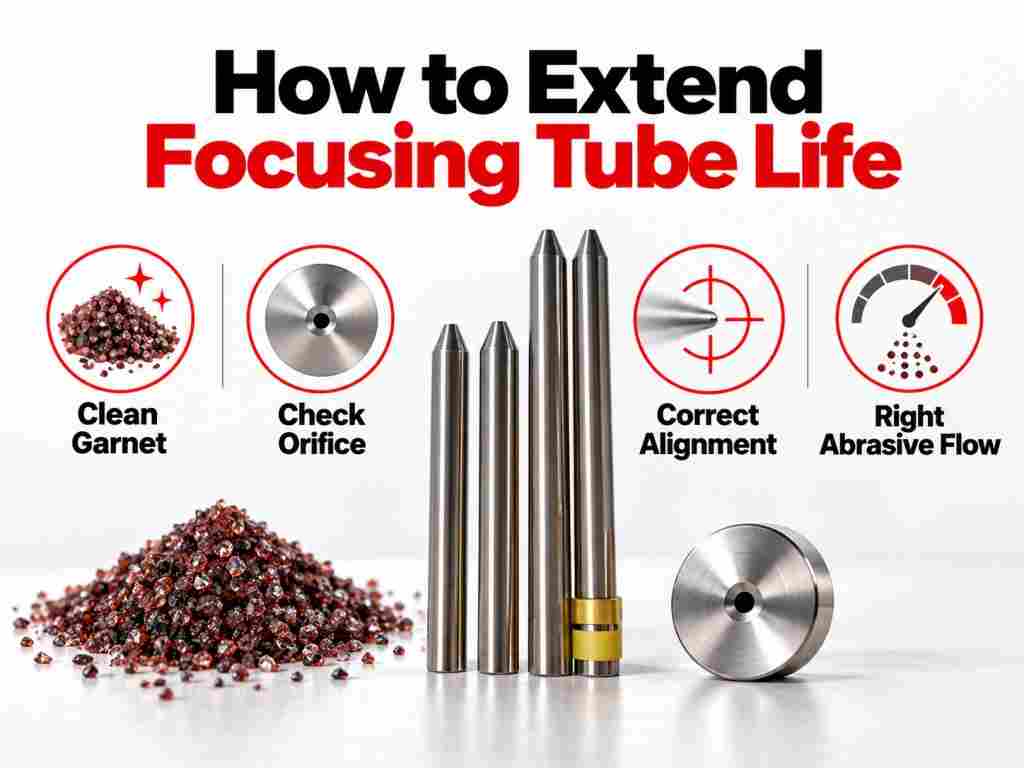
To minimize unnecessary wear on the focusing tube:
Use clean, dry garnet abrasive
Select the appropriate abrasive mesh size
Regularly inspect the nozzle (jewel orifice)
Maintain precise cutting head alignment
Avoid excessive abrasive flow rates
Use a focusing tube of the correct size
Clean the mixing chamber during maintenance
Use a reliable Carbide Focusing Tube
Regular inspections often allow issues to be detected before cutting quality is significantly compromised.
How KUNDA Helps Customers
KUNDA supplies waterjet focusing tubes, jewel orifices, mixing chambers, abrasive inlet assemblies, cutting head components, and other consumables.
We can help you select the right focusing tube based on the following parameters:
Part number, inner diameter, outer diameter, length, cutting head model, jewel orifice size, and photos of the used part.
We offer compatible parts for a wide range of waterjet systems, including brands such as FLOW, KMT, OMAX, AccuStream, WSI, BFT, Resato, and Techni.
If your focusing tube is wearing out prematurely, please send the tube dimensions, jewel orifice size, cutting head model, and photos of the worn tube to KUNDA. We will assist you in troubleshooting the issue and recommending a suitable replacement.
While focusing tube wear is normal, an excessively short service life often indicates underlying problems.
Common causes include poor abrasive quality, damaged jewel orifices, misalignment, excessive abrasive flow, incorrect specifications, and inferior tube material.
Identifying the root cause helps reduce consumable costs and improves the stability of your waterjet cutting operations.
Contact Us
Email: info@kundacnc.com
WhatsApp: +86 157 9367 0759
FAQ
1. Why does my focusing tube wear on only one side?
One-sided wear often indicates that the water stream is not entering the focusing tube centrally. Check the orifice, mixing chamber, installation, and alignment.
2. Can a damaged orifice shorten focusing tube life?
Yes. A damaged orifice may create an irregular or misaligned water stream that accelerates focusing tube wear.
3. Does more abrasive make cutting faster?
Not necessarily. Excessive abrasive may increase cost and focusing tube wear without providing a proportional improvement in cutting performance.
4. Should the orifice and focusing tube be replaced together?
Not always. However, when focusing tube wear becomes abnormal, the orifice should be inspected at the same time.
5. Can KUNDA help identify the correct focusing tube?
Yes. Send us the part number, dimensions, cutting head model, or old part photos, and we can help match the suitable focusing tube.

No previous


