Waterjet Solutions
Can a 3-axis Waterjet Cutting Head Be Upgraded To a 5-axis Cutting Head?
Can a 3-axis Waterjet Cutting Head Be Upgraded To a 5-axis Cutting Head?
Many Waterjet Cutting Machine users, after operating their equipment for several years, may find themselves needing to cut bevels, chamfers, or complex 3D parts. This often leads to a common question:
Can an existing 3-axis waterjet cutting machine be converted by simply swapping in a 5-axis cutting head?
While such a conversion is possible, not all 3-axis Waterjet Machines are suitable for an upgrade—and, in most cases, replacing the cutting head alone is not enough.
A proper 5-axis upgrade requires verifying that the mechanical structure, control system, servo drives, software, and high-pressure plumbing are all compatible and capable of supporting the change.
What is the difference between 3-axis and 5-axis waterjet cutting?
Standard 3-axis Water Jet Cutting Machine primarily relies on:
X-axis + Y-axis + Z-axis
to perform 2D contour cutting.
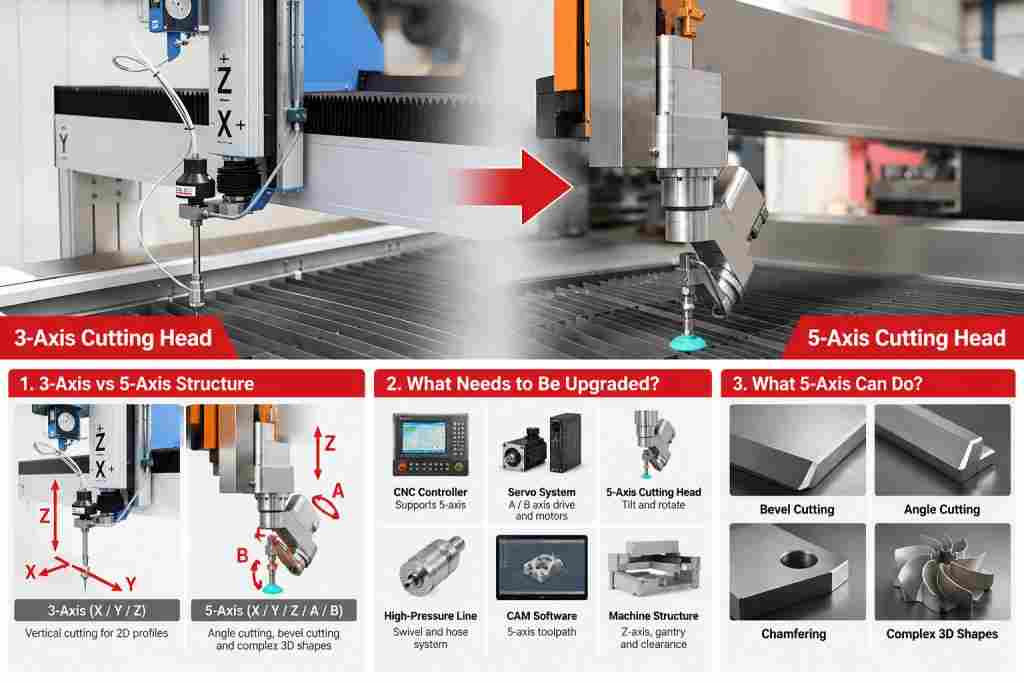
5-axis Waterjet Cutter adds two rotational or tilting axes to the X, Y, and Z axes, allowing the cutting head to be angled as needed.
Consequently, a 5-axis system enables:
Bevel cutting
Angled-surface cutting
Taper compensation
Preparation of weld bevels
Chamfering
Certain complex 3D contours
Why can’t you just replace it with a five-axis head?
1. The Z-axis must be capable of supporting a 5-axis cutting head.
Compared to standard 3-axis Abrasive Water Jet Cutter Heads, 5-axis cutting heads are typically:
Heavier, larger, and possess higher motion inertia.
Therefore, it is essential to verify:
The load-bearing capacity of the Z-axis.
The rigidity of the guide rails.
The structure of the ball screws or rack-and-pinion system.
The power of the Z-axis motor.
The rigidity of the gantry/crossbeam.
If the original machine structure is too lightweight, even if a 5-axis head is successfully installed, it may compromise motion accuracy and stability.
2. Evaluate the control system.
A 5-axis cutting head typically incorporates two additional servo-driven rotary axes.
Consequently, the existing control system must be capable of managing:
X + Y + Z + A + B—a total of five motion axes.
If the original controller is limited to 3-axis operation, you will need to add or replace the following components:
Motion controller.
Servo drives.
Servo motor controls.
I/O modules.
5-axis control software.
Therefore, before purchasing a 5-axis cutting head, do not merely check the mechanical dimensions; you must first verify the capabilities of the control system.
3. The high-pressure piping system requires a redesign.
This is a detail frequently overlooked by many clients.
While the high-pressure piping for a 3-axis Abrasive Waterjet Cutter Head is relatively straightforward, a 5-axis head involves constant, dynamic movement.
As a result, you must carefully reconsider:
The layout of high-pressure piping.
High-pressure rotary joints (swivels).
High-pressure hoses.
Abrasive delivery lines.
Cable routing.
Anti-entanglement design.
Failure to address these factors can lead to fatigue, mechanical interference, or wear on the high-pressure lines during long-term operation.
4. The software must support 5-axis toolpaths.
Equipping a machine with a 5-axis cutting head does not automatically grant it true 5-axis machining capability.
The CAM software must also be capable of accurately generating:
Cutting angles
A/B-axis motion
Tool-tip trajectories
Beveling paths
3D toolpaths
The primary value of 5-axis waterjet cutting lies in advanced angular cutting, beveling, taper compensation, and complex 3D machining.
5. The range of motion (swing space) for the 5-axis head must be considered.
A standard 3-axis Abrasive Waterjet Cutting Machine head remains essentially vertical.
A 5-axis cutting head, by contrast, tilts significantly during operation.
Therefore, it is essential to verify:
Whether the cutting head might collide with the gantry (crossbeam)
Whether it might collide with the workpiece
Whether it might collide with the water tank
Whether the Z-axis travel is sufficient
Whether the usable cutting area is effectively reduced
Some manufacturers explicitly state that multi-axis attachments may reduce the machine's effective travel range.
What should you verify before upgrading from a 3-axis to a 5-axis system?
If you are planning an upgrade, it is recommended to prepare the following information:
Brand of the waterjet cutting machine
Machine model
Control system model
Photograph of the Z-axis
Z-axis travel range
Servo motor model
Control card model
High-pressure pump model
Operating pressure
Photograph of the current cutting head
Desired 5-axis functionality
Based on this information, an engineer can determine whether the upgrade requires:
Direct installation of a 5-axis cutting head;
Installation of a 5-axis cutting head combined with a control system upgrade; or
A complete overhaul to a full 5-axis system.
Which machines are suitable for an upgrade?
An existing waterjet cutting machine is generally worth further evaluation if it meets the following criteria:
The mechanical structure is relatively new.
The gantry (crossbeam) has good rigidity.
The Z-axis has sufficient load-bearing capacity.
The controller supports the addition of extra axes.
The servo system is sufficiently open/flexible.
The Z-axis travel range is adequate.
The machine maintains a high level of overall precision.
For such equipment, a five-axis upgrade often allows for the continued use of the existing:
Machine frame + water tank + X/Y motion platform + high-pressure pump.
The primary modifications focus on the cutting head, control system, and related accessories.
Which machines are not suitable for a 5-axis retrofit?
If a machine has been in service for many years and exhibits the following issues—
worn guide rails,insufficient rigidity in the crossbeam,an undersized Z-axis,an obsolete control system,a controller that cannot be expanded,a lack of compatible 5-axis CAM software,or a decline in overall machine precision—then investing significant capital into a 5-axis upgrade may not be cost-effective.
In such cases, you should compare two options:the cost of retrofitting the existing machine for 5-axis capability versus the cost of purchasing a new 5-axis waterjet cutting machine.
If the controller, motors, Z-axis assembly, and software all require replacement, the upgrade costs may well approach the price of a brand-new machine.
How does KUNDA assist its clients?
Based on the specifications of a client’s existing waterjet cutting machine, KUNDA can assess the feasibility of a 5-axis upgrade and provide the following:
5-axis installation solutions
Servo motors and drives
Compatible control systems
High-pressure swivels and piping components
Waterjet cutting head accessories
High-pressure pumps and spare parts
Comprehensive 5-axis Waterjet Cutting Solutions
Before purchasing a 5-axis head, we strongly recommend that clients provide machine specifications for compatibility verification, rather than purchasing the head first and attempting installation afterward.
While it is indeed possible to upgrade a 3-axis waterjet machine to 5-axis, a "5-axis upgrade" involves much more than simply swapping out the cutting head.
The following components must be properly matched:
Cutting Head + Mechanical Structure + CNC Controller + Servo System + High-Pressure Lines + CAM Software
If the existing machine structure and control system possess the necessary expandability, a 5-axis upgrade can significantly enhance the equipment's capability to process bevels, inclined surfaces, and complex contours.
However, if the equipment is too outdated—requiring the replacement of a large number of mechanical and control components—it may be more practical to purchase a new 5-axis Waterjet Cutting System instead.
Contact Us
Email: info@kundacnc.com
WhatsApp: +86 157 9367 0759

FAQ:
1. Can a 3-axis waterjet cutting machine always be upgraded to a 5-axis system?
Not necessarily. It is essential to first verify whether the Z-axis structure, control system, servo interfaces, and software support such an upgrade.
2. Can I simply purchase a 5-axis cutting head and use it immediately?
In most cases, no. Typically, you will also need A/B-axis control, servo drives, electrical connections, and 5-axis-compatible software.
3. Does the existing high-pressure pump need to be replaced?
Not necessarily. If the pressure and flow rate of the current high-pressure pump meet the requirements for the new cutting tasks, it can usually continue to be used.
4. What capabilities are gained after upgrading to a 5-axis system?
The upgrade primarily enables features such as beveling, angled cuts, chamfering, taper compensation, and certain complex 3D cutting operations.
5. How can I determine if my machine is eligible for an upgrade?
You can provide photos of the entire machine, details on the Z-axis structure, the controller model, servo motor models, and information about your current cutting head; our engineers will then evaluate whether an upgrade is feasible.