Waterjet Knowledge
How to Reduce Waterjet Abrasive Consumption?
How to Reduce Waterjet Abrasive Consumption?
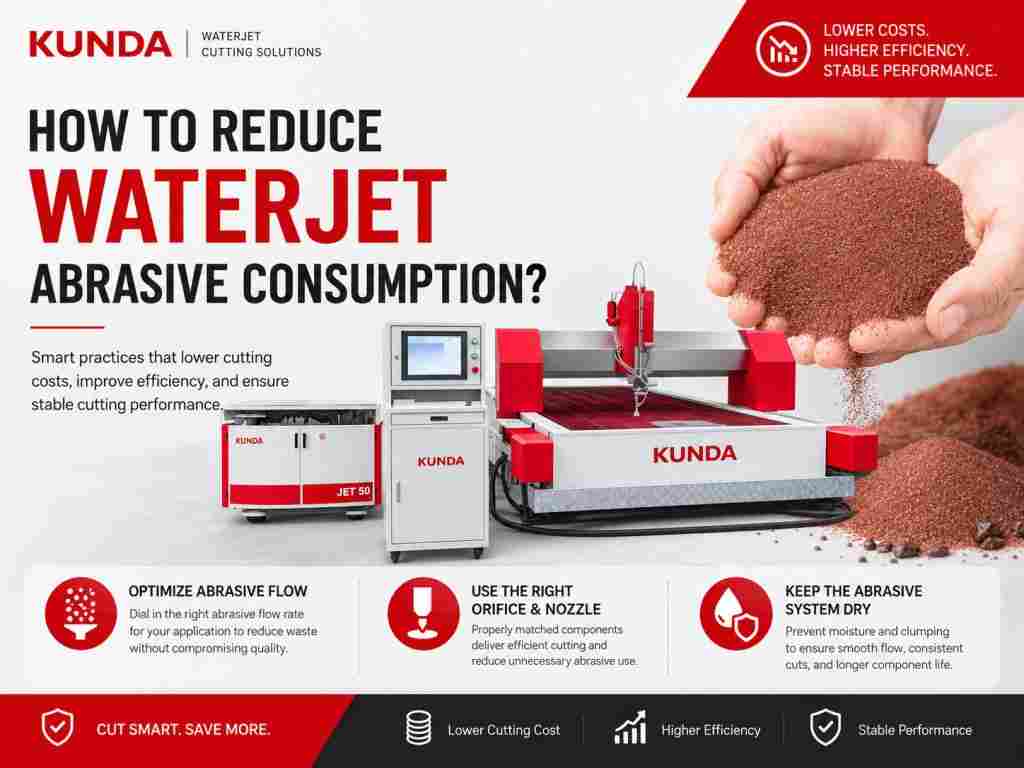
In abrasive waterjet cutting, abrasive consumption represents one of the most significant components of daily operating costs. Many waterjet users rely on garnet abrasives daily to cut metal, stone, glass, ceramics, composites, and other hard materials.
Excessive abrasive consumption causes total cutting costs to escalate rapidly. Furthermore, incorrect abrasive settings can lead to poor cut quality, nozzle wear, unstable cutting streams, and unnecessary production waste.
Reducing waterjet abrasive consumption does not simply mean using less abrasive. If the abrasive flow rate is too low, cutting speeds may drop, preventing the material from being cut properly. A better approach is to strike an optimal balance between abrasive flow rate, pump pressure, nozzle size, Focusing Tube condition, cutting speed, and material thickness.
KUNDA supplies Waterjet Equipment, cutting head components, nozzles, focusing tubes, Abrasive Nozzles, pump parts, and compatible spares to customers worldwide. This article outlines how waterjet users can reduce abrasive consumption and improve cutting efficiency.
Why Abrasive Consumption Matters
Abrasive is a standard consumable in waterjet cutting. For customers who operate waterjet equipment daily, the cost of abrasive can constitute a significant portion of total production costs.
High abrasive consumption can lead to:
Higher cutting costs
More frequent abrasive replenishment
Increased waste
Accelerated nozzle wear
More frequent machine adjustments
Lower production efficiency
Higher long-term operating costs
For waterjet cutting facilities, reducing unnecessary abrasive waste is an effective way to control costs and increase profits.
1. Set the Correct Abrasive Flow Rate
A common mistake is using an excessive amount of abrasive. Some operators believe that more abrasive results in faster cutting speeds, but this is not always the case.
If the abrasive flow rate is too high, some of the abrasive may not be fully accelerated by the water jet; this leads to waste and may fail to improve cutting performance.
If the abrasive flow rate is too low, cutting capability may be compromised, cutting speed may decrease, and the machine may fail to cut through the material effectively.
The correct abrasive flow rate should be determined by:
Material type
Material thickness
Pump pressure
Orifice size
Focusing tube size
Cutting speed
Required edge quality
Customers should adjust the abrasive flow rate based on actual cutting conditions rather than using the same settings for all materials.
2. Choose the Right Orifice and Focusing Tube Combination
The combination of the nozzle and the focusing tube directly affects abrasive consumption.
The nozzle generates a high-speed water jet, while the focusing tube facilitates the mixing and acceleration of the abrasive. If these components are mismatched, the abrasive may not be utilized efficiently.
An improper combination can lead to:
Unstable cutting jet
Poor abrasive mixing
Higher abrasive consumption
Wider kerf (cut width)
Poor edge quality
Pump pressure drop
Reduced nozzle lifespan
For example, if the orifice is too large for the pump's capacity, the pump may fail to maintain stable pressure. If the focusing tube is severely worn or mismatched with the orifice, abrasive cutting efficiency will decrease.
KUNDA can assist customers in selecting the appropriate nozzle and focusing tube based on pump model, operating pressure, cutting material, and material thickness.
3. Check Focusing Tube Wear Regularly
The focusing tube is one of the most critical consumables in waterjet cutting. As it wears, its inner diameter gradually increases, diminishing the focusing effect of the cutting stream.
A worn focusing tube can lead to:
Poor cutting precision
Wider kerf (cut width)
Rough cut edges
Slower cutting speeds
Higher abrasive consumption
Increased material waste
Many customers continue using worn focusing tubes, mistakenly believing it saves money. In reality, a severely worn tube can actually increase abrasive costs and compromise cut quality.
Regular inspection and timely replacement help maintain a stable cutting stream and minimize unnecessary abrasive waste.
4. Use Good Quality Abrasive
Abrasive quality also affects cutting efficiency. Low-quality abrasives may contain dust, impurities, uneven particles, or moisture, leading to unstable feed rates, nozzle clogs, and accelerated wear on the focusing tube.
High-quality abrasives should feature consistent particle size, low dust content, and hardness suitable for waterjet cutting.
Poor abrasive quality can result in:
Abrasive clogs
Unstable abrasive flow
Accelerated nozzle wear
Rough cut surfaces
Reduced cutting efficiency
Increased machine downtime
Selecting the right abrasive helps customers minimize waste and enhance cutting performance.
5. Keep the Abrasive Feeding System Dry and Clean
Excessive humidity is a common cause of abrasive feed issues. If the abrasive becomes damp, it can clog the abrasive delivery line, hopper, metering valve, or mixing chamber.
Abrasive clogs can lead to unstable cutting and may force operators to unnecessarily increase abrasive settings.
Customers should keep the abrasive system dry and inspect the following:
Abrasive hopper
Abrasive metering valve
Abrasive feed tube
Mixing chamber
Water supply conditions
Abrasive storage area
A clean, dry abrasive system helps maintain a consistent abrasive flow and reduces waste.
6. Cutting speed is directly proportional to abrasive consumption.
If the cutting speed is too slow, the machine may consume more abrasive than necessary; if the speed is too fast, cutting quality may suffer, or the material may not be cut through completely.The correct cutting speed should be matched to the following factors:
Material thickness
Material hardness
Cutting quality requirements
Pump pressure
Abrasive flow rate
Orifice and nozzle sizes
For simple cutting tasks, excessively slow speeds or high abrasive flow rates may not be required. Optimizing cutting speed can reduce abrasive usage while maintaining acceptable cutting quality.
7. Maintain stable pump pressure
Stable pump pressure is crucial for cutting efficiency. If pump pressure drops or fluctuates, the cutting stream becomes unstable, preventing the abrasive from functioning effectively.Pump pressure issues can be caused by:
Worn high-pressure seals
Check valve problems
Accumulator issues
Insufficient water supply
Hydraulic system problems
Incorrect orifice size
High-pressure leaks
If pressure is unstable, simply increasing the abrasive flow rate will not solve the problem. Customers should inspect the pump system and replace worn components as necessary.
KUNDA supplies Waterjet Pump parts, high-pressure seals, seal kits, check valve components, accumulators, ceramic plungers, and other high-pressure assemblies to help customers maintain stable pump performance.
8. Avoid increasing abrasive flow when cutting thick materials
When cutting thick materials, some operators tend to excessively increase the abrasive flow rate. However, excessive abrasive does not always improve cutting speed or edge quality.For thick materials, customers should consider the overall cutting conditions, including:
Pump pressure
Orifice size
Focusing tube size
Cutting speed
Abrasive quality
Pierce settings
Required edge quality
A proper configuration can usually achieve better cutting performance with reasonable abrasive consumption.
9. Promptly Replace Worn Cutting Head Components
Abrasive consumption may increase when cutting head components are worn or damaged.Customers should regularly inspect:
Orifices
Focusing tubes
Mixing chambers
Abrasive nozzles
Abrasive feed tubes
On/off valve components
Cutting head alignment
If these components are worn, the abrasive mixing process can become inefficient. Prompt replacement helps reduce abrasive waste and improves cutting stability.
10. Establish a Regular Maintenance Schedule
A sound maintenance plan helps reduce abrasive consumption and lowers overall cutting costs.Customers should keep records of:
Abrasive flow settings
Focusing tube service life
Orifice replacement intervals
Changes in cutting quality
Pump pressure status
Common clogging issues
Material cutting parameters
By tracking these details, customers can identify optimal cutting parameters for different materials, thereby avoiding unnecessary waste.
How does KUNDA help customers reduce abrasive consumption?
KUNDA helps waterjet users worldwide improve cutting efficiency and lower operating costs by providing reliable waterjet components and practical technical support.KUNDA supplies:
Waterjet nozzles
Ruby orifices
Sapphire orifices
Diamond orifices
Focusing tubes
Abrasive nozzles
Mixing chambers
Abrasive feed tubes
Cutting head components
On/off valve components
Waterjet pump components
High-pressure seals
Seal kits
Check valve parts
Accumulators
Filters and maintenance tools
KUNDA also offers compatible waterjet accessories for many mainstream brands, including FLOW, KMT, OMAX, AccuStream, BFT, WSI, Resato, Techni, and other waterjet systems.
If customers are unsure which orifice, focusing tube, or abrasive nozzle is required, they can provide us with the following details:
Machine brand
Pump model
Cutting head type
Operating pressure
Current orifice size
Current focusing tube size
Material being cut
Material thickness
Current abrasive flow setting
Description of cutting quality issues
Our team will assist in identifying suitable options and provide practical component solutions.
Reducing waterjet abrasive consumption is not just about using less abrasive; it is about optimizing the entire cutting process. KUNDA is ready to provide global waterjet users with reliable consumables, compatible spare parts, and practical technical support.
To reduce abrasive consumption, please provide KUNDA with details regarding your equipment model, pump model, cutting material, material thickness, and the abrasive size currently in use; we will assist you in determining the appropriate solution.
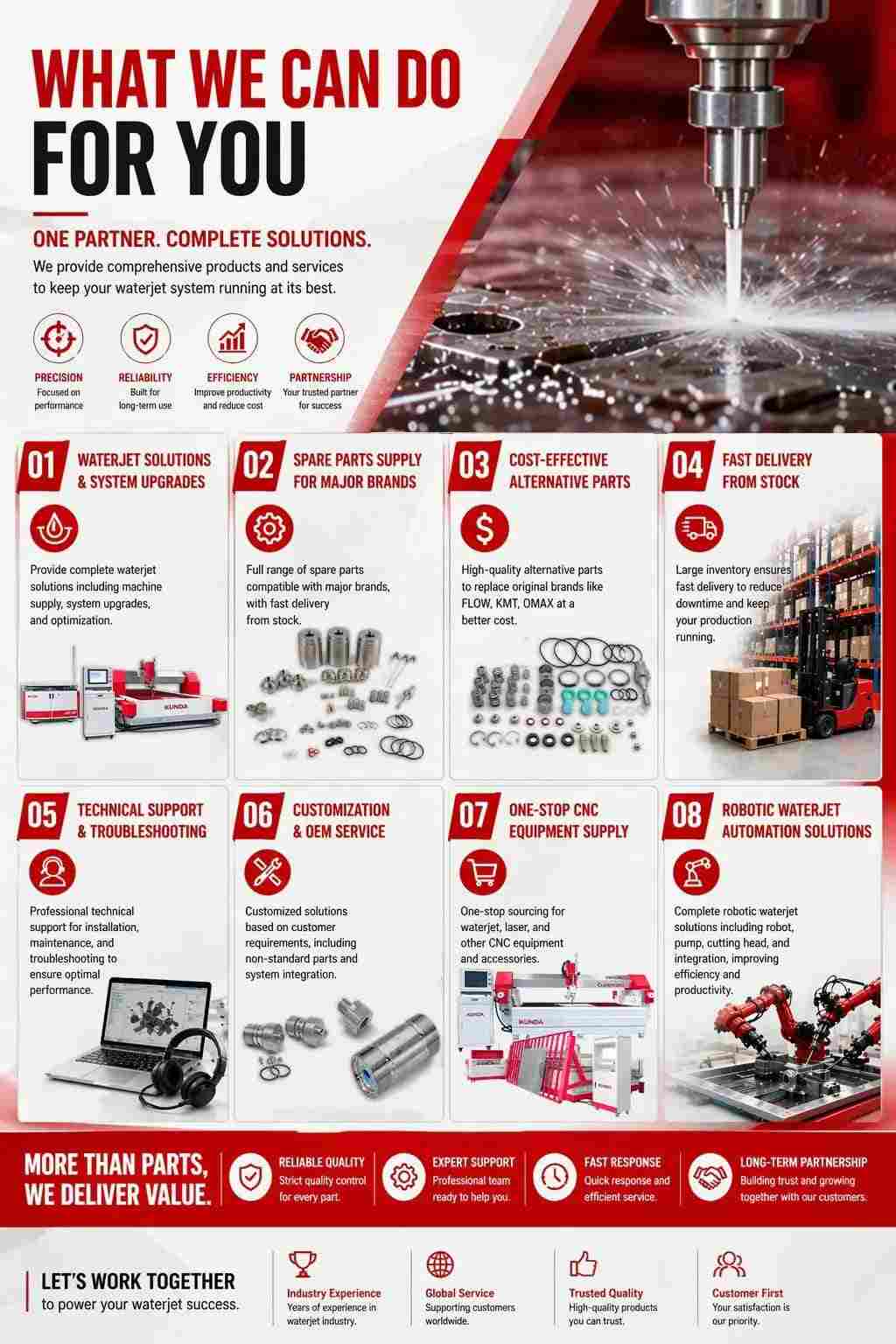
FAQ: Waterjet Abrasive Consumption
1. Why is my waterjet consuming excessive abrasive?
Excessive abrasive consumption can result from an excessively high abrasive flow rate, a worn-out focusing tube, a mismatch between the nozzle and orifice, a cutting speed that is too slow, or unstable pump pressure.2. Does using more abrasive mean faster cutting speeds?
No. Using excessive abrasive does not always increase cutting speed. If the waterjet cannot sufficiently accelerate the abrasive, it leads to waste and potentially higher operating costs.3. How can I reduce abrasive costs?
You can reduce abrasive costs by setting the correct flow rate, using the right combination of nozzles and focusing tubes, promptly replacing worn nozzles, keeping the abrasive system dry, and maintaining stable pump pressure.4. Does a worn focusing tube increase abrasive consumption?
Yes. A worn focusing tube causes the cutting stream to widen and lose focus, which can reduce cutting efficiency and lead to increased abrasive consumption.5. Does abrasive quality affect consumption?
Yes. Poor-quality abrasive may contain dust, moisture, or uneven particles, leading to clogs, inconsistent feeding, accelerated nozzle wear, and reduced cutting efficiency.6. Can the wrong orifice size increase abrasive waste?
Yes. If the orifice is too large or incompatible with the pump's flow rate, pump pressure may become unstable, reducing cutting efficiency and wasting abrasive.7. How often should I replace the focusing tube?
Replacement intervals depend on operating pressure, abrasive quality, cutting duration, material type, and required cut quality. You should inspect the focusing tube if the kerf widens or the cut edge becomes rough.8. Can KUNDA help select the right abrasive nozzle and orifice?
Yes. KUNDA can assist customers in selecting the appropriate orifices, focusing tubes, abrasive nozzles, and cutting head components based on machine brand, pump model, pressure, material type, thickness, and cutting requirements.